
Continuo
'Story from my secret life' series

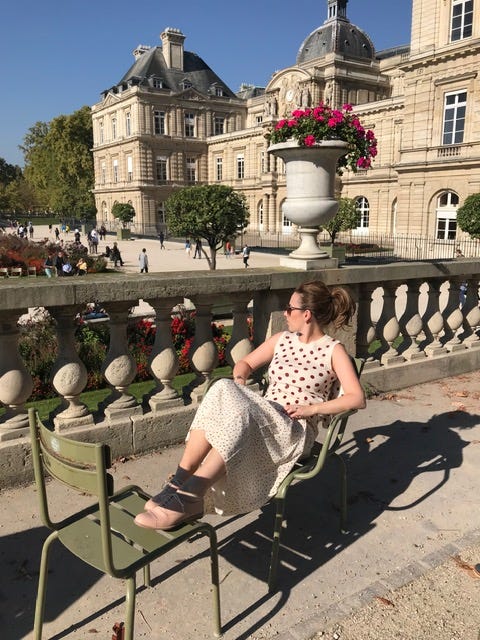
Jardin du Luxembourg, Saturday, 3 p.m., 28°C in the shade — a rare patch of shade where the green chairs are crammed together, stamped by the Senate, which owns the place. A lot of people, and it will be worse in an hour or two, after the meals that drag on at the packed terraces of the neighbourhood.
The man alone has managed to sit a little apart from the clotted chairs, to read a book in relative quiet. The muffled noise of the conversations blends into the birdsong and the children’s shouts. The man alone likes this, this music of the garden, made of living sounds, of breaths of air passing through leaves and through human or animal throats. It is like a soundtrack to what he is reading, barely audible behind the words spoken by the characters in the novel, whom he thinks he can hear too.
The man alone makes his own private cinema, and as on each of his afternoons in the garden, his book is a run of long takes in which the novelistic figures seem to come towards him, circling his motionless chair and his body set down in the calm shade. People pass slowly, discreetly, perhaps they feel obliged to take on attitudes dictated by the bourgeois civility of the Second Empire, as if the destiny of the lawns and the flowerbeds, decided back in those days, still taught “good manners”.
The man alone feels a joy in thinking it as he is watching the tourists in tourist getup lower their voices in the Haussmannian walks, softly slipping their foreign tongues into the mass of sound of the garden, more and more musical with these unexpected soloists surfacing over the continuo of the wind, the songs and the cries. The mood is fragile, and the man alone is all the more aware of it in that suddenly, right in front of him, on the far side of the path, two women come and sit down and put a phone on speaker for a conversation he wants to know nothing about.
The metallic sound has invaded the calm shade all at once, the dozing ones have startled awake, the readers have lifted their heads, nothing is possible any longer of what the various people had come here to find. The man alone protests, he is answered “rights and freedoms”, he retorts “consideration, pilots, harmony”, and his anger breaks out at the deafness of the two obtuse women, unable to share the atmosphere of the garden in a whisper, unable to be there in the company of the Parisians brought to a standstill for a few hours or only a few minutes under the trees, before heading off again to busy themselves in the noisy windings of the great city.
I initially wrote this story in French, and above you have my translation in English. Here is the original text. And you can also listen to it.
Jardin du Luxembourg, samedi, 15h00, 28°C à l’ombre - une ombre rare où s’entassent les chaises vertes estampillées par le Sénat, propriétaire des lieux. Beaucoup de monde, et ce sera pire dans une heure ou deux, après les repas qui s’éternisent sur les terrasses bondées du quartier.
L’homme seul a réussi à s’asseoir un peu à l’écart des chaises agglutinées, pour lire un livre dans une quiétude relative. Le bruit étouffé des conversations se mêle aux chants d’oiseaux et aux cris d’enfants. L’homme seul aime ça, cette musique du jardin, composée de sons vivants, des soufflés d’air qui passent à travers des feuilles et des gorges humaines ou animales. C’est comme une bande-son de ce qu’il lit, à peine audible derrière les mots prononcés par les personnages de roman, qu’il croit entendre aussi.
L’homme seul fait son cinéma intime, ainsi qu’à chacune de ses après-midis au jardin, son livre est une suite de plans-séquence où les silhouettes romanesques semblent venir à lui, tournant autour de sa chaise immobile et de son corps posé dans l’ombre calme. Les gens passent lentement, discrètement, peut-être se sentent-ils obligés d’adopter des attitudes dictées par la civilité bourgeoise du second Empire, comme si le destin des pelouses et des parterres, choisi en ce temps-là, enseignant encore les “bonnes manières”.
L’homme seul ressent une joie à le penser en voyant les touristes en tenue de touriste baisser le ton dans les allées haussmanniennes, glissant doucement leurs langues étrangères dans la masse sonore du jardin, de plus en plus musicale avec ces affleurements de solistes inattendus sur la basse continue du vent, des chants et des cris. L’ambiance est fragile, l’homme seul en est d’autant plus conscient que soudain face à lui, de l’autre côté de l’allée, deux femmes viennent s’assoir en ouvrant le haut-parleur d’un téléphone pour une conversation dont il ne veut rien savoir.
Le son métallique a envahi d’un coup l’ombre calme, les endormis ont sursauté, les lecteurs ont levé la tête, plus rien n’est possible de ce qu’étaient venus chercher les uns et les autres. L’homme seul proteste, on lui répond “droits et libertés”, il réplique “égards, pilotes, harmonie” et sa colère éclate devant la surdité des deux obtuses, incapables de partager dans un chuchotement l’atmosphère du jardin, incapables d’être là dans la compagnie des Parisiens à l’arrêt quelques heures ou seulement quelques minutes sous les arbres, avant de repartir s’affairer dans les méandres bruyants de la grande ville.
Tamara Arden — T;A
Not a tip jar. A ledger for what you underlined in your mind
The Semicolon Affair exists because of its amazing readers. If you want to be part of it, subscribe or upgrade, I’d be grateful and glad to have you.
It's amazing how you've managed to make me feel outraged for "the man alone" without actually conveying outrage. "Rights and freedoms" really pushed it over the edge. This is conveying without telling; making me feel, not instructing me, which only a skilled writer can do.
The bilingual mirroring is the real achievement, reading the story replicates the very thing "the man alone" is doing, layering a private continuo beneath the public score. Barthes had a term for this, “le bruissement de la langue”, the rustle of language as ambient texture rather than message. The phone violates the “unintentionality” of sound. Birdsong doesn't address you; a speakerphone conversation, however banal, is addressed to the world whether the world consented or not. That's the real trespass. You’re an amazing writer.